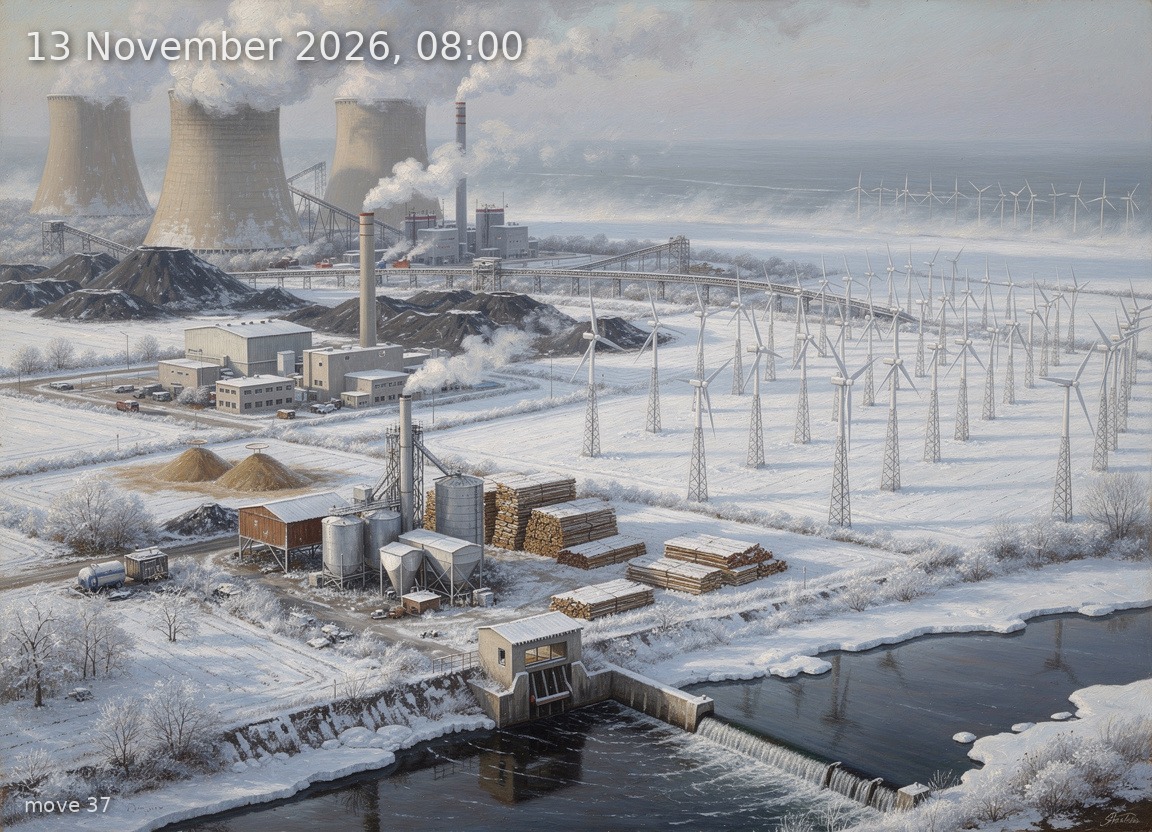
Strong wind generation leads at 35.3 GW, but sub-zero temperatures and zero solar push thermal plants and net imports to cover 67.1 GW demand.
Generation mix
Wind onshore 49%
Wind offshore 9%
Biomass 6%
Hydro 2%
Natural gas 14%
Hard coal 7%
Brown coal 13%
66%
Renewable share
35.3 GW
Wind (on + offshore)
0.0 GW
Solar
61.0 GW
Total generation
6.2 GW
Net import
202.2 EUR/MWh
Day-ahead price
-1.4°C / 3 km/h
Temp / Wind speed
Open-Meteo, Kassel (51.3°N 9.5°E) · surface estimate from 100 m wind
37.0% / 0.8 W/m²
Cloud cover / Radiation
228
gCO₂/kWh
Image prompt
Wind onshore 29.8 GW dominates the right two-thirds of the scene as vast rows of three-blade turbines with lattice towers stretching across a frozen, frost-covered north German plain, their rotors turning slowly; wind offshore 5.5 GW appears as distant turbines on the far-right horizon above a steel-grey sea. Natural gas 8.7 GW fills the centre-left as a cluster of compact CCGT power plants with tall single exhaust stacks emitting thin white plumes. Brown coal 7.8 GW occupies the left background as massive hyperbolic cooling towers releasing thick billowing steam columns into the cold air, with conveyor belts of dark lignite visible at their base. Hard coal 4.3 GW appears as a smaller conventional power station with square stacks and darker smoke adjacent to the lignite plant. Biomass 3.8 GW is rendered as a mid-ground industrial wood-chip plant with a modest chimney and stacked timber. Hydro 1.0 GW appears as a small run-of-river weir with turbine house in the near foreground along a frozen-edged river. No solar panels anywhere — zero solar generation. The time is 08:00 in mid-November: a cold early-morning light, pale and weak, filters through a sky that is partially cloudy (37% cloud cover), with patches of grey-blue and thin high clouds, the sun barely above the horizon casting a flat, wan illumination with long shadows. Temperature is -1.4°C: hoarfrost coats every surface — bare deciduous trees, brown stubble fields, metal railings, turbine bases. The atmosphere feels heavy and oppressive reflecting a high electricity price — a brooding, weighty sky with muted tones and a faintly hazy, industrial pall over the thermal plants. Style: highly detailed oil painting in the tradition of 19th-century German Romantic landscape painters such as Caspar David Friedrich and Carl Blechen — rich, sombre colour palette of steel blues, ash greys, umber browns, and faint amber from the low sun; visible impasto brushwork in the steam plumes and frost textures; deep atmospheric perspective with layers of mist between the wind farm and the coal plants; meticulous engineering accuracy in every turbine nacelle, cooling tower paraboloid, gas-turbine exhaust detail, and conveyor mechanism. No text, no labels.