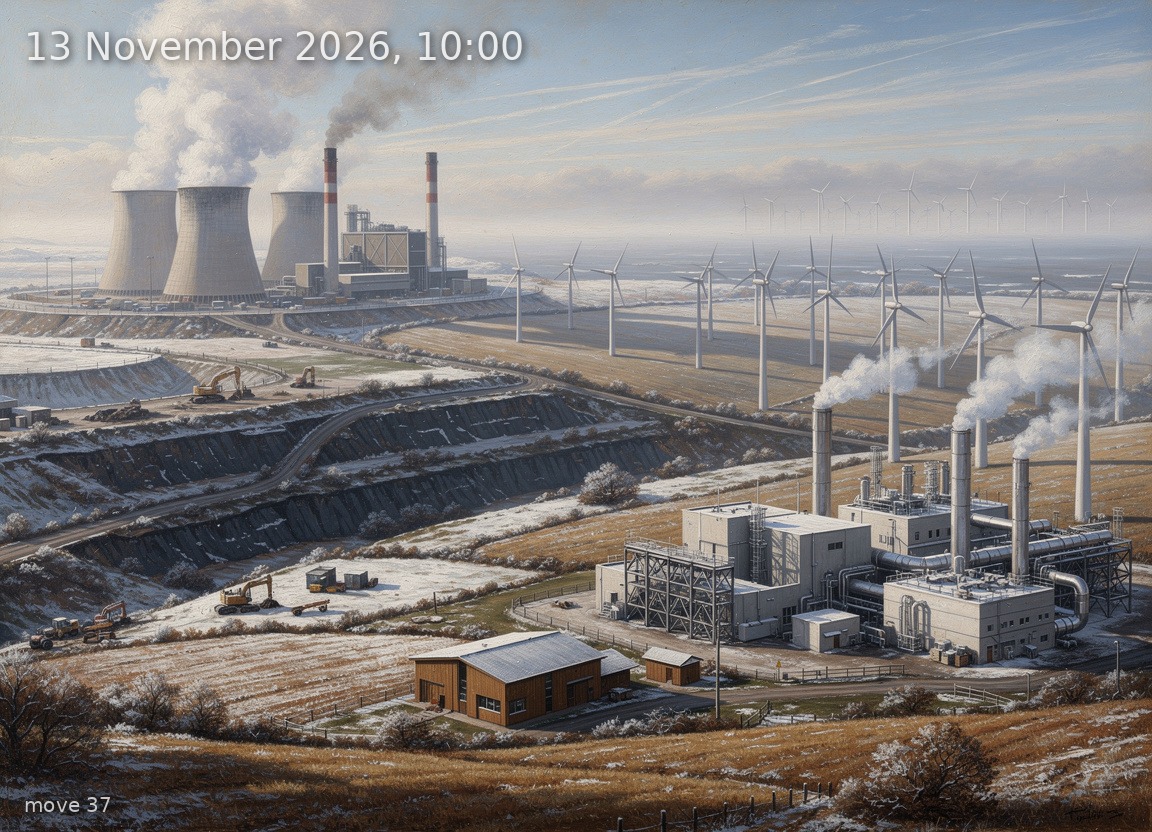
Strong wind and substantial coal and gas backup meet high winter demand with zero solar on a cold November morning.
Generation mix
Wind onshore 44%
Wind offshore 8%
Solar 0%
Biomass 7%
Hydro 2%
Natural gas 18%
Hard coal 8%
Brown coal 13%
61%
Renewable share
33.6 GW
Wind (on + offshore)
0.0 GW
Solar
64.1 GW
Total generation
4.7 GW
Net import
114.4 EUR/MWh
Day-ahead price
1.5°C / 8 km/h
Temp / Wind speed
Open-Meteo, Kassel (51.3°N 9.5°E) · surface estimate from 100 m wind
10.0% / 113.3 W/m²
Cloud cover / Radiation
255
gCO₂/kWh
Image prompt
Wind onshore 28.2 GW dominates the right two-fifths of the scene as dense ranks of modern three-blade turbines with white tubular towers and nacelles stretching across rolling brown-stubble farmland into atmospheric distance; natural gas 11.3 GW fills the centre-right as a cluster of compact CCGT power stations with slim single exhaust stacks emitting thin white plumes; brown coal 8.3 GW occupies the left quarter as massive hyperbolic cooling towers releasing thick billowing steam columns, beside open-pit mine terraces with exposed dark lignite seams; hard coal 5.4 GW appears centre-left as a classic coal-fired station with tall rectangular boiler houses and twin chimneys trailing grey smoke; wind offshore 5.4 GW is visible in the far background right as a line of turbines standing in a misty grey North Sea horizon; biomass 4.3 GW appears as a modest wood-clad combined heat and power plant with a conical woodchip silo near centre; hydro 1.3 GW is a small concrete run-of-river weir with water spilling over, tucked into the left foreground beside bare willow trees. Time is 10:00 AM mid-November: full but subdued daylight, sky mostly clear with only thin high cirrus, yet the sunlight is low-angled and pale, casting long cold shadows across frost-tipped fields. Temperature 1.5 °C: bare deciduous trees, patches of frost on grass, breath-visible air from a lone worker near the gas plant. Despite only 10% cloud cover, the November sun is weak and watery, casting a cool silvery light. Atmosphere feels heavy and oppressive reflecting the high electricity price — a leaden quality to the air despite the clear sky, industrial haze pooling in low valleys. No solar panels visible anywhere. Style: highly detailed oil painting in the tradition of 19th-century German Romantic landscape painters such as Caspar David Friedrich and Carl Blechen — rich impasto brushwork, deep atmospheric perspective, dramatic tonal contrasts between warm industrial emissions and cold natural landscape, meticulous engineering accuracy in every turbine nacelle, cooling tower curve, and smokestack detail. No text, no labels.