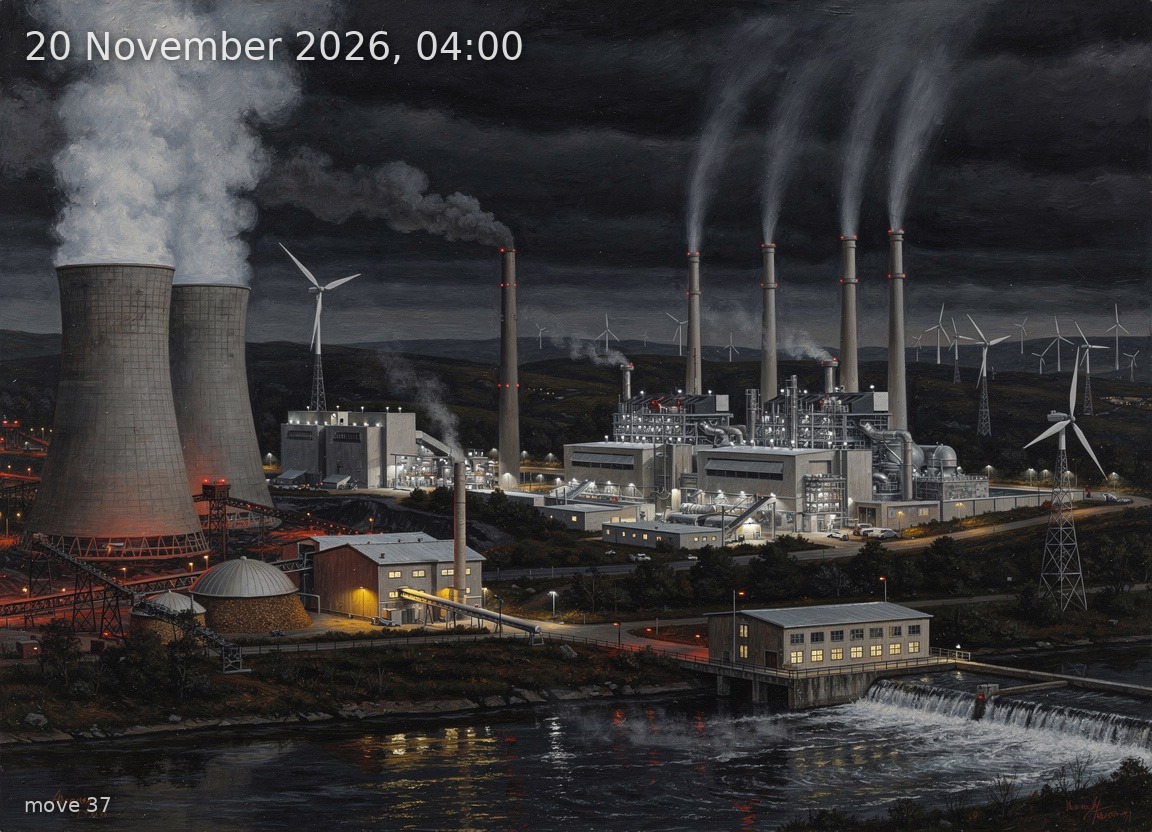
Gas, brown coal, and onshore wind dominate a tight overnight grid requiring 4.7 GW net imports at elevated prices.
Generation mix
Wind onshore 32%
Wind offshore 3%
Biomass 9%
Hydro 2%
Natural gas 27%
Hard coal 11%
Brown coal 17%
46%
Renewable share
16.3 GW
Wind (on + offshore)
0.0 GW
Solar
46.5 GW
Total generation
4.7 GW
Net import
171.1 EUR/MWh
Day-ahead price
6.3°C / 4 km/h
Temp / Wind speed
Open-Meteo, Kassel (51.3°N 9.5°E) · surface estimate from 100 m wind
100.0% / 0.0 W/m²
Cloud cover / Radiation
346
gCO₂/kWh
Image prompt
Natural gas 12.4 GW dominates the centre-right of the scene as a cluster of large combined-cycle gas turbine plants with tall slender exhaust stacks venting pale heat plumes into the black sky; brown coal 7.7 GW fills the left quarter as massive hyperbolic cooling towers with thick white steam columns rising from a sprawling lignite power station, conveyor belts visible at their base; hard coal 4.9 GW appears as a smaller coal-fired station just left of centre with rectangular boiler houses and a single tall chimney trailing grey smoke; onshore wind 15.1 GW spans the right third and distant background as dozens of three-blade turbines on lattice and tubular towers standing across dark rolling hills, red aviation warning lights blinking on nacelles; offshore wind 1.2 GW is suggested by a few faint red lights on the far-right horizon over a strip of dark sea; biomass 4.2 GW appears as a modest industrial facility with a wood-chip storage dome and short stack near the centre-left; hydro 1.0 GW is a small run-of-river station at the bottom of the composition beside a dark river reflecting the industrial glow. Time is 04:00 — deep night, completely dark sky with no twilight or sky glow, heavy 100% overcast hiding all stars, oppressive low cloud ceiling lit from below by sodium-orange and industrial white light from the power stations. Temperature is 6°C in late November: bare deciduous trees, damp ground, thin mist clinging to the river valley. The atmosphere feels heavy and pressurized, conveying the high electricity price through visual weight — dense steam, thick clouds pressing down, an almost suffocating industrial density. Rendered as a highly detailed oil painting in the tradition of 19th-century German Romantic landscape art — rich impasto brushwork, deep chiaroscuro contrasts between the black sky and the warm industrial glow, atmospheric perspective fading distant turbine lights into haze, meticulous engineering accuracy in every cooling tower curve, turbine nacelle, and exhaust stack. No text, no labels.