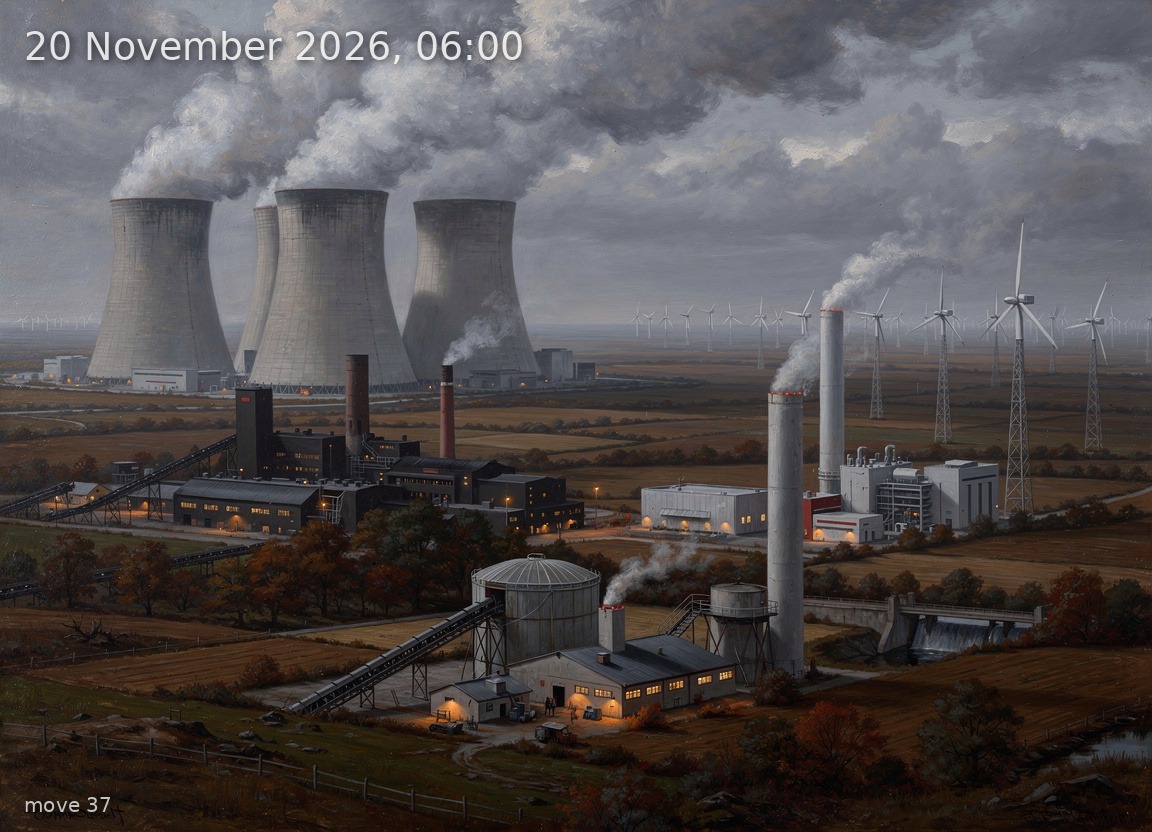
Gas, brown coal, and wind dominate generation as zero solar and high demand drive imports and elevated prices.
Generation mix
Wind onshore 30%
Wind offshore 3%
Biomass 9%
Hydro 2%
Natural gas 27%
Hard coal 10%
Brown coal 18%
45%
Renewable share
15.7 GW
Wind (on + offshore)
0.0 GW
Solar
46.8 GW
Total generation
14.9 GW
Net import
212.3 EUR/MWh
Day-ahead price
6.1°C / 4 km/h
Temp / Wind speed
Open-Meteo, Kassel (51.3°N 9.5°E) · surface estimate from 100 m wind
100.0% / 0.0 W/m²
Cloud cover / Radiation
358
gCO₂/kWh
Image prompt
Wind onshore 14.2 GW spans the right third of the scene as dozens of three-blade turbines with lattice towers receding into misty distance across rolling farmland; natural gas 12.5 GW occupies the centre-right as a cluster of compact CCGT plants with tall single exhaust stacks venting thin white plumes; brown coal 8.5 GW dominates the left quarter as massive hyperbolic cooling towers emitting thick columns of steam into the low overcast; hard coal 4.8 GW appears centre-left as a traditional coal-fired station with rectangular chimney stacks and conveyor belts feeding dark fuel; biomass 4.2 GW is rendered as a mid-sized industrial plant with a wood-chip storage dome and modest smokestack slightly left of centre; wind offshore 1.5 GW is glimpsed in the far background as faint turbine silhouettes along a grey horizon suggesting the North Sea; hydro 1.1 GW appears as a small dam structure nestled in a valley in the distant right background. The time is 06:00 in late November — pre-dawn, with only the faintest pale grey-blue light along the eastern horizon, the sky otherwise deep charcoal-grey under total 100% cloud cover, no stars visible, no direct sunlight, no solar panels anywhere. The atmosphere feels heavy, oppressive, and dense, reflecting the high 212 EUR/MWh price — low-hanging clouds press down on the industrial landscape. Temperature is 6°C: late-autumn bare deciduous trees with skeletal branches, damp brown grass, patches of frost on rooftops. Surface wind is light at 3.6 km/h so ground-level flags hang limp and smoke rises nearly vertically, though turbine blades turn slowly at hub height. Sodium-orange streetlights and industrial floodlights illuminate the power stations, casting warm pools of artificial light against the cold blue-grey pre-dawn murk. Reflections glint off wet roads and puddles. Style: highly detailed oil painting in the tradition of 19th-century German Romantic landscape painting — Caspar David Friedrich's atmospheric depth merged with industrial realism — rich layered colour, visible impasto brushwork, dramatic chiaroscuro between artificial light and natural darkness, meticulous engineering accuracy on every turbine nacelle, cooling tower, and exhaust stack. No text, no labels.