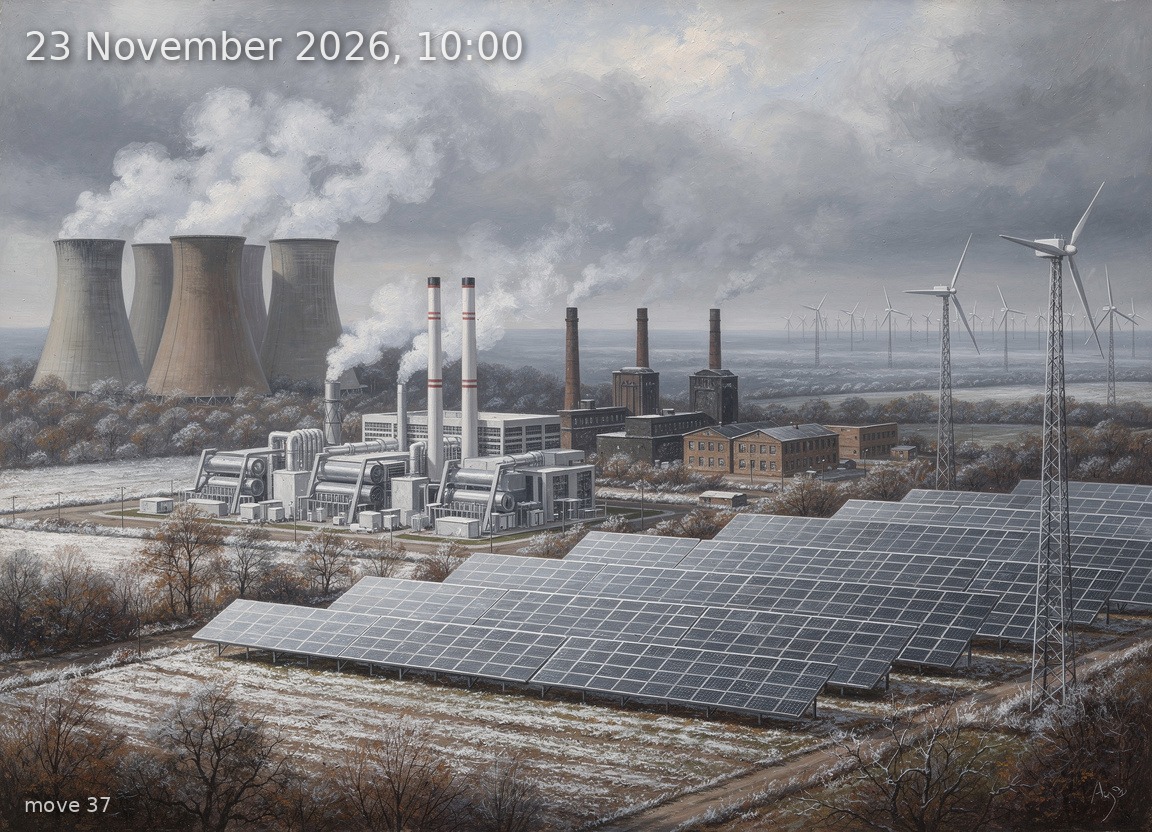
Gas, brown coal, and diffuse-light solar dominate as cold temperatures and high demand drive 245 EUR/MWh prices.
Generation mix
Wind onshore 14%
Wind offshore 4%
Solar 24%
Biomass 7%
Hydro 2%
Natural gas 23%
Hard coal 11%
Brown coal 17%
50%
Renewable share
11.5 GW
Wind (on + offshore)
15.3 GW
Solar
64.7 GW
Total generation
4.9 GW
Net import
245.2 EUR/MWh
Day-ahead price
-0.0°C / 8 km/h
Temp / Wind speed
Open-Meteo, Kassel (51.3°N 9.5°E) · surface estimate from 100 m wind
85.0% / 25.8 W/m²
Cloud cover / Radiation
326
gCO₂/kWh
Image prompt
Brown coal 10.7 GW occupies the left quarter as a cluster of massive hyperbolic cooling towers with thick white steam plumes rising into the overcast sky; natural gas 14.6 GW fills the centre-left as a row of modern CCGT power plants with tall slender exhaust stacks emitting heat shimmer; hard coal 6.8 GW appears behind them as older rectangular boiler houses with twin chimneys; solar 15.3 GW stretches across the centre-right as vast fields of aluminium-framed crystalline silicon PV panels on frost-dusted ground, angled south, catching weak diffuse daylight under heavy clouds; wind onshore 9.1 GW rises across the right third as dozens of three-blade turbines on lattice and tubular towers, blades turning slowly in light wind; wind offshore 2.4 GW is glimpsed as distant turbines on a grey horizon line; biomass 4.5 GW appears as a medium-sized industrial facility with a wood-chip storage dome and a single smokestack near the right edge; hydro 1.1 GW is a small concrete dam with a thin waterfall at the far right margin. The scene is set at 10:00 on a late-November morning: full but muted daylight, the sky a uniform heavy grey-white overcast at 85% cloud cover, no direct sun visible, the light flat and cold. The landscape is a broad German lowland plain, bare deciduous trees with no leaves, fields covered in light frost, temperature precisely 0°C with visible breath-like mist near ground level. The atmosphere feels oppressive and heavy, reflecting the 245 EUR/MWh price—dense low clouds pressing down on the industrial panorama. Rendered as a highly detailed oil painting in the tradition of 19th-century German Romantic landscape painters such as Caspar David Friedrich and Carl Blechen, with rich earthy and slate-grey tones, visible impasto brushwork, atmospheric aerial perspective fading into grey distance, meticulous engineering accuracy on every turbine nacelle, every cooling tower's parabolic curve, every PV panel's grid pattern. No text, no labels, no people prominent—only the monumental industrial landscape under a brooding winter sky.