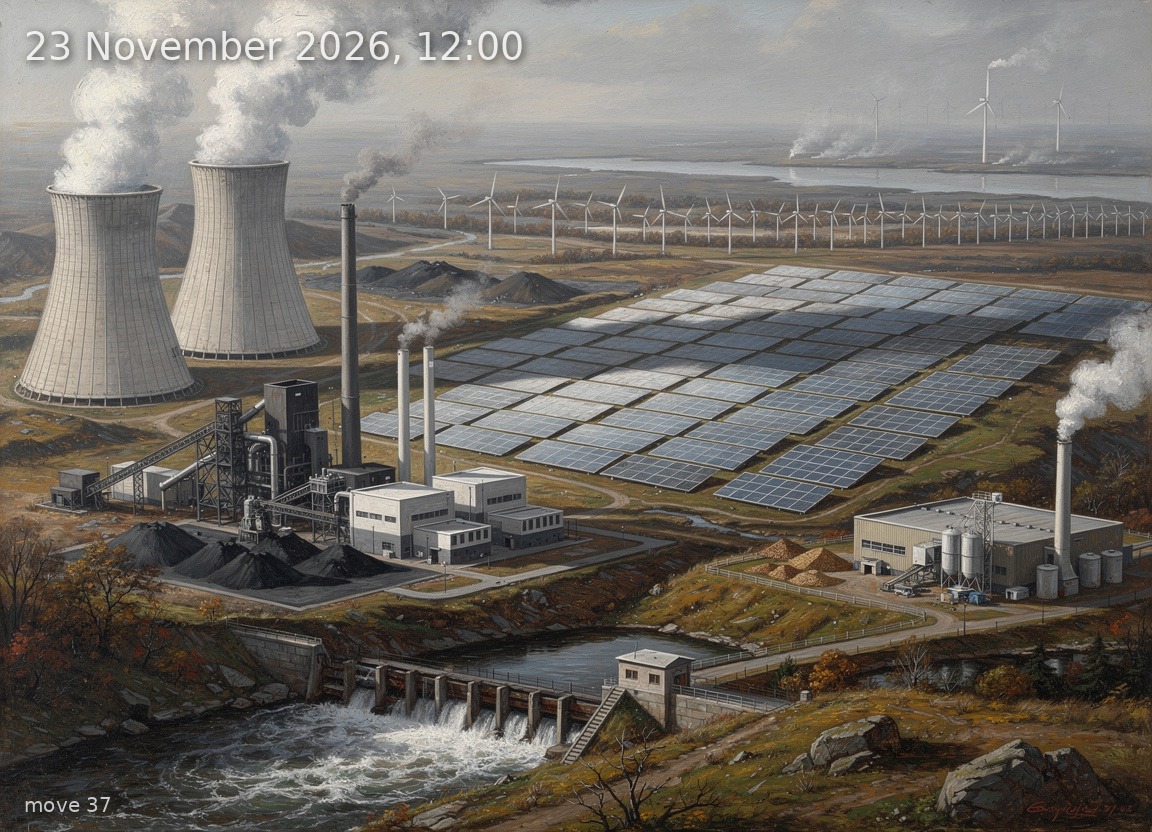
Gas, coal, and midday solar drive a tight 70 GW grid on a cold, lightly windy November noon.
Generation mix
Wind onshore 12%
Wind offshore 3%
Solar 29%
Biomass 7%
Hydro 2%
Natural gas 23%
Hard coal 11%
Brown coal 15%
52%
Renewable share
10.3 GW
Wind (on + offshore)
19.7 GW
Solar
68.2 GW
Total generation
1.9 GW
Net import
208.8 EUR/MWh
Day-ahead price
2.0°C / 8 km/h
Temp / Wind speed
Open-Meteo, Kassel (51.3°N 9.5°E) · surface estimate from 100 m wind
52.0% / 134.5 W/m²
Cloud cover / Radiation
309
gCO₂/kWh
Image prompt
Solar 19.7 GW dominates the centre-right as vast fields of aluminium-framed crystalline silicon PV panels catching pale midday winter light; natural gas 15.4 GW fills the centre-left as a cluster of compact CCGT power stations with tall single exhaust stacks venting thin white plumes; brown coal 10.0 GW anchors the far left as three massive hyperbolic cooling towers with billowing steam columns rising into the sky; hard coal 7.2 GW appears just left of centre as a classic coal plant with conveyor belts and a tall chimney stack trailing grey smoke; wind onshore 8.5 GW stretches along the distant horizon as a row of three-blade turbines on lattice towers turning lazily; wind offshore 1.9 GW is suggested by a few smaller turbines on the far horizon above a grey-blue sea inlet; biomass 4.5 GW appears as a modest wood-chip-fed plant with a low industrial building and a single smokestack near the right edge; hydro 1.2 GW is a small dam and weir visible in a river cutting through the lower foreground. Time of day is noon in late November: low-angle winter sun at roughly 20° elevation, cool diffuse daylight filtered through 52% broken cloud cover, patches of direct sunlight alternating with cloud shadow across the landscape. The atmosphere feels heavy and oppressive, a leaden quality to the grey-white clouds suggesting high electricity prices. Temperature is 2 °C: bare deciduous trees, brown dormant grass, frost lingering in shadows, no snow but a raw wintry chill visible in muted earth tones. Wind is light — turbine blades barely turning, smoke and steam plumes rising mostly vertically with only slight drift. Style: highly detailed oil painting in the tradition of 19th-century German Romantic landscape painters such as Caspar David Friedrich and Carl Blechen — rich impasto brushwork, atmospheric depth with aerial perspective fading distant elements into haze, warm-cool colour contrasts between the pale solar reflections and the dark industrial silhouettes. Each technology rendered with meticulous engineering accuracy: nacelle housings, rotor hubs, PV module grid patterns, cooling tower parabolic profiles, conveyor gantries. The composition reads as a sweeping panoramic industrial landscape, grand in scale, contemplative in mood. No text, no labels.