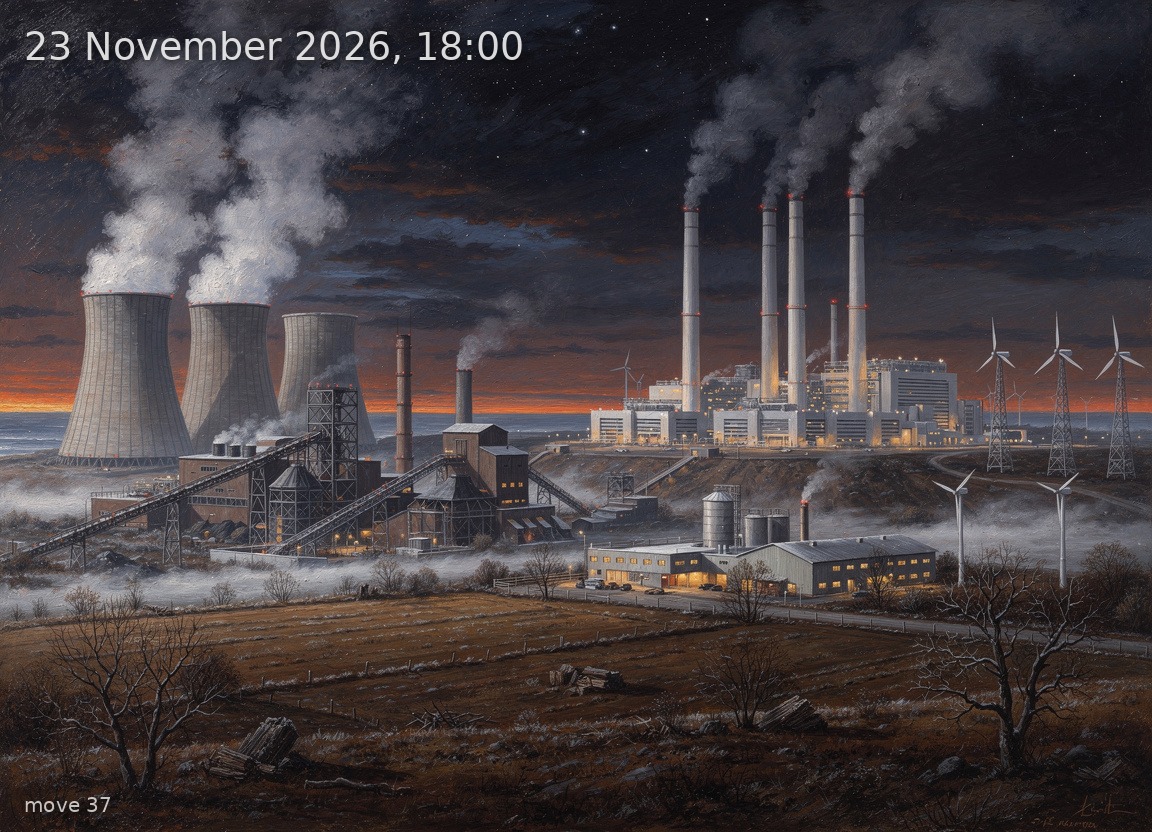
Gas, brown coal, and hard coal dominate evening generation as freezing temperatures and zero solar drive peak demand and high prices.
Generation mix
Wind onshore 24%
Wind offshore 4%
Biomass 8%
Hydro 2%
Natural gas 30%
Hard coal 13%
Brown coal 19%
38%
Renewable share
14.4 GW
Wind (on + offshore)
0.0 GW
Solar
52.4 GW
Total generation
16.9 GW
Net import
316.8 EUR/MWh
Day-ahead price
0.3°C / 4 km/h
Temp / Wind speed
Open-Meteo, Kassel (51.3°N 9.5°E) · surface estimate from 100 m wind
0.0% / 0.0 W/m²
Cloud cover / Radiation
400
gCO₂/kWh
Image prompt
Natural gas 15.7 GW dominates the centre-right of the composition as a cluster of large CCGT power plants with tall single exhaust stacks venting pale plumes into the cold air; brown coal 9.8 GW occupies the left quarter as three massive hyperbolic cooling towers with thick white steam columns rising against the dark sky; hard coal 7.0 GW appears centre-left as a heavy industrial plant with conveyor belts and shorter stacks trailing grey smoke; wind onshore 12.3 GW spans the right third of the scene as a long row of three-blade turbines on lattice towers along a ridgeline, blades barely turning in the light 3.8 km/h breeze; biomass 4.4 GW is rendered as a mid-ground wood-chip-fed plant with a modest stack and warm amber-lit windows; wind offshore 2.0 GW is suggested by distant turbines on a far horizon line; hydro 1.2 GW appears as a small dam structure with illuminated spillway at the far right edge. Time of day is 18:00 in late November — deep dusk with a thin dying band of burnt-orange and crimson light along the very lowest horizon, the sky above rapidly darkening to deep indigo and near-black, first stars visible overhead. The landscape is flat to gently rolling North German lowland, bare winter trees with no leaves, frost-covered brown fields, temperature near freezing with a faint mist at ground level. The atmosphere feels heavy and oppressive, reflecting the extreme 316.8 EUR/MWh electricity price — the sky presses down with brooding weight. Sodium-orange streetlights and facility lighting cast warm pools of artificial light across the industrial foreground. All rendered as a highly detailed oil painting in the tradition of 19th-century German Romantic landscape art — rich impasto brushwork, deep atmospheric perspective, dramatic chiaroscuro between the glowing industrial facilities and the encroaching winter darkness. Meticulous engineering detail on every turbine nacelle, cooling tower ribbing, CCGT exhaust stack, and conveyor structure. No text, no labels.