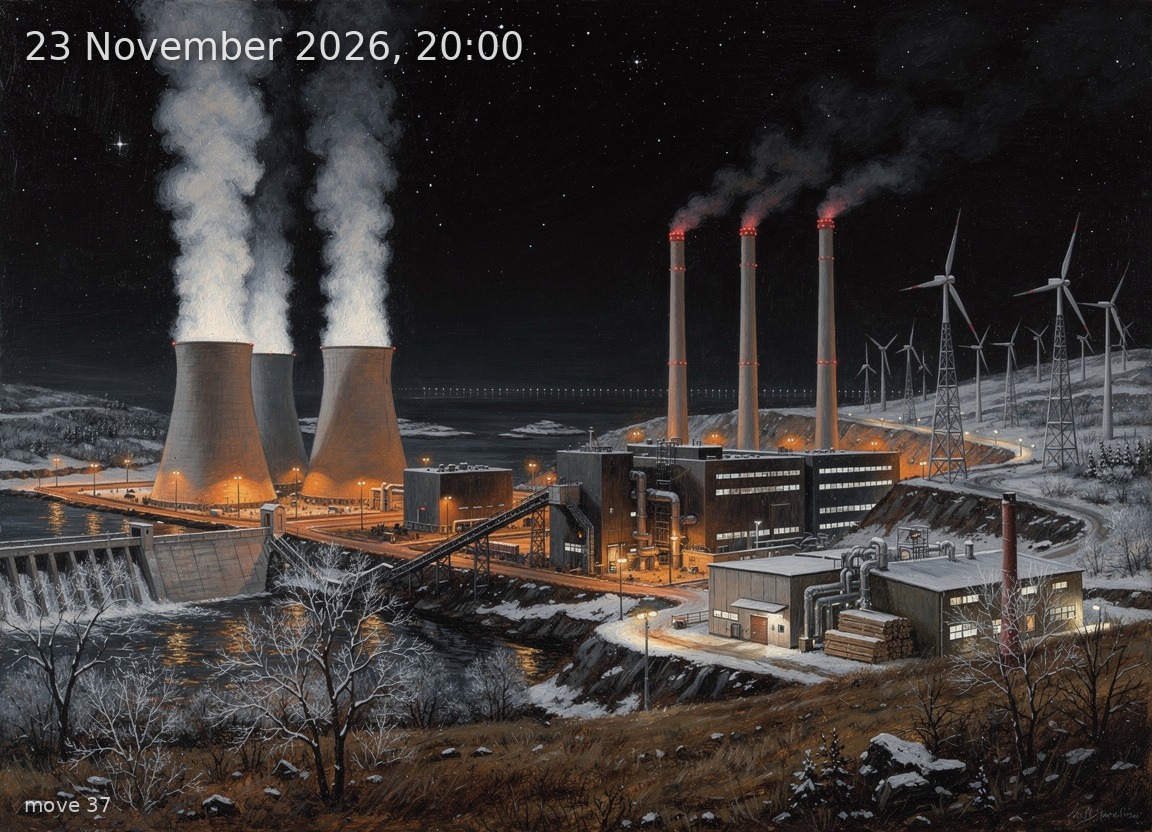
Gas, brown coal, and hard coal anchor a winter evening grid as sub-zero cold lifts demand beyond domestic supply.
Generation mix
Wind onshore 22%
Wind offshore 3%
Biomass 9%
Hydro 2%
Natural gas 33%
Hard coal 12%
Brown coal 19%
36%
Renewable share
13.1 GW
Wind (on + offshore)
0.0 GW
Solar
52.1 GW
Total generation
12.5 GW
Net import
282.1 EUR/MWh
Day-ahead price
-1.2°C / 4 km/h
Temp / Wind speed
Open-Meteo, Kassel (51.3°N 9.5°E) · surface estimate from 100 m wind
0.0% / 0.0 W/m²
Cloud cover / Radiation
407
gCO₂/kWh
Image prompt
Natural gas 17.0 GW dominates the centre-right as a sprawling complex of compact CCGT units with tall single exhaust stacks venting pale plumes into frigid air; brown coal 9.9 GW fills the left quarter as massive hyperbolic cooling towers emitting thick white steam columns rising vertically in the still, freezing atmosphere; hard coal 6.4 GW appears as a mid-sized coal plant with conveyor belts and a cluster of rectangular chimneys just left of centre; wind onshore 11.4 GW stretches across the far right as dozens of three-blade turbines on lattice and tubular towers along a low ridge, blades turning slowly; wind offshore 1.7 GW is barely visible as a distant row of turbines on the far horizon; biomass 4.6 GW appears as a modest industrial facility with stacked timber and a single smokestack near the right foreground; hydro 1.2 GW is a small dam structure with spillway at the far left edge. The scene is set at 20:00 in deep winter night — the sky is entirely black, no twilight, no glow on the horizon, a perfectly clear starfield visible overhead with zero cloud cover. All structures are lit by harsh sodium-orange industrial lighting, security floodlights, and the red aviation warning lights atop the wind turbines and smokestacks. Frost coats the bare deciduous trees and dormant brown grass in the foreground; a thin layer of ice glistens on a canal in the mid-ground reflecting the orange industrial glow. The atmosphere is heavy and oppressive despite clear skies, conveying extreme cost and strain — a faint haze of condensation hangs close to the ground from the sub-zero temperature of minus one degree Celsius. Rendered as a highly detailed oil painting in the tradition of 19th-century German Romantic landscape painters such as Caspar David Friedrich and Carl Blechen — rich, saturated darks, visible impasto brushwork, dramatic chiaroscuro between the black sky and the warm industrial fires, atmospheric depth receding into inky distance, meticulous engineering accuracy on every turbine nacelle, cooling tower profile, and gas-turbine exhaust stack. No text, no labels.