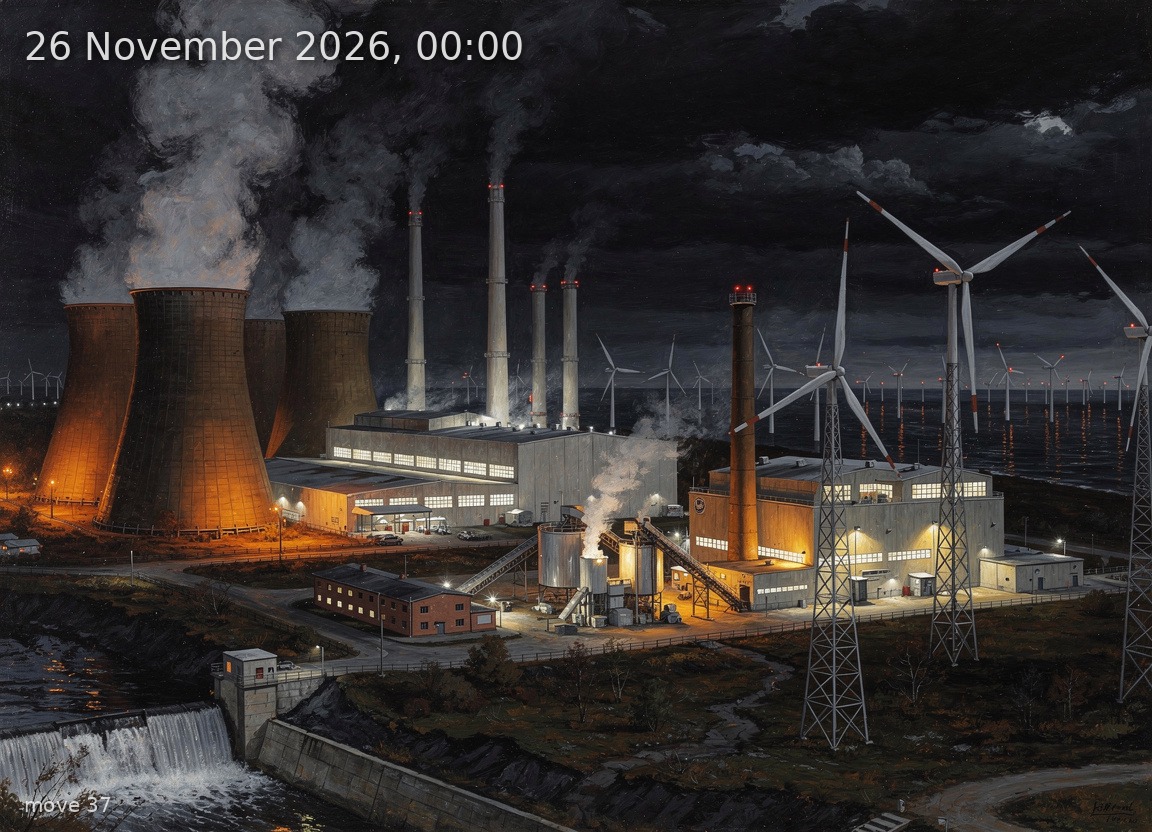
Wind and a large thermal fleet drive 60 GW generation at midnight, with 6.9 GW net exports into a high-price European market.
Generation mix
Wind onshore 30%
Wind offshore 11%
Biomass 7%
Hydro 2%
Natural gas 23%
Hard coal 10%
Brown coal 17%
50%
Renewable share
24.3 GW
Wind (on + offshore)
0.0 GW
Solar
60.3 GW
Total generation
+6.9 GW
Net export
204.4 EUR/MWh
Day-ahead price
-1.1°C / 17 km/h
Temp / Wind speed
Open-Meteo, Kassel (51.3°N 9.5°E) · surface estimate from 100 m wind
93.0% / 0.0 W/m²
Cloud cover / Radiation
330
gCO₂/kWh
Image prompt
Brown coal 10.3 GW dominates the left quarter of the scene as a cluster of massive hyperbolic cooling towers with thick white-grey steam plumes billowing upward into the black sky, lit from below by orange sodium lamps; natural gas 13.8 GW occupies the left-centre as a sprawling CCGT complex with tall slender exhaust stacks emitting thin heat shimmer, its turbine halls glowing with interior fluorescent light through tall windows; hard coal 6.1 GW appears centre-right as a compact power station with a single large stack and conveyor belts visible under yellow industrial floodlights; wind onshore 17.9 GW spans the right third and background as dozens of tall three-blade turbines on lattice and tubular towers, their red aviation warning lights blinking against the deep-black overcast sky, blades visibly turning in strong wind; wind offshore 6.4 GW is suggested in the far-right distance as a line of turbines standing in dark water, nacelle lights reflecting on small waves; biomass 4.4 GW appears as a modest wood-chip-fired plant with a squat stack and steam, nestled between the gas and coal facilities; hydro 1.3 GW is a small dam structure at the far left edge with water cascading under floodlight. The sky is completely dark, no twilight, no stars — a 93% overcast winter midnight, heavy oppressive low clouds faintly lit from below by the industrial glow, suggesting high energy prices and tension. The ground is dusted with frost, bare deciduous trees with rime on their branches stand between the installations, temperature at minus one degree Celsius. Patches of frozen puddles reflect sodium-orange light. Overhead high-voltage transmission lines on steel lattice pylons stretch across the scene carrying export power. Highly detailed oil painting in the tradition of 19th-century German Romantic landscape painters — rich dark palette of blacks, deep blues, amber and ochre, visible expressive brushwork, dramatic chiaroscuro, atmospheric depth with industrial haze — rendered with meticulous engineering accuracy for each technology. No text, no labels.