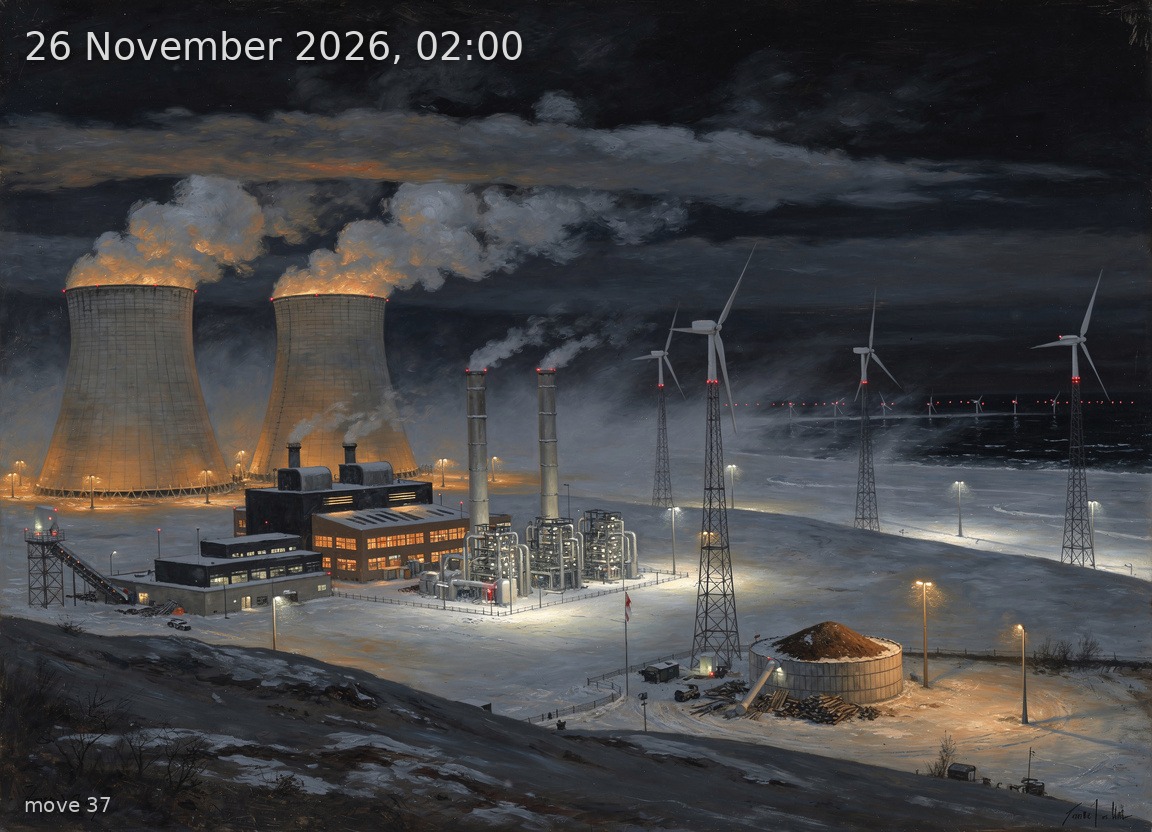
Wind and thermal baseload drive 58 GW of generation into sub-zero night demand with strong net exports.
Generation mix
Wind onshore 30%
Wind offshore 10%
Biomass 7%
Hydro 2%
Natural gas 22%
Hard coal 10%
Brown coal 18%
50%
Renewable share
23.5 GW
Wind (on + offshore)
0.0 GW
Solar
58.3 GW
Total generation
+7.2 GW
Net export
201.0 EUR/MWh
Day-ahead price
-0.5°C / 13 km/h
Temp / Wind speed
Open-Meteo, Kassel (51.3°N 9.5°E) · surface estimate from 100 m wind
92.0% / 0.0 W/m²
Cloud cover / Radiation
329
gCO₂/kWh
Image prompt
Wind onshore 17.4 GW dominates the right half of the scene as dozens of tall three-blade turbines with white nacelles and lattice towers stretching across frozen rolling hills, rotors visibly spinning; wind offshore 6.1 GW appears on the far right horizon as a distant cluster of turbines with red aviation lights blinking above a dark sea; brown coal 10.3 GW occupies the left foreground as three massive hyperbolic cooling towers emitting thick white steam plumes lit from below by orange sodium lamps; natural gas 13.1 GW fills the centre-left as a row of compact CCGT power stations with tall single exhaust stacks and illuminated steel pipe arrays venting thin plumes; hard coal 5.7 GW appears behind the gas plant as a blocky industrial building with twin stacks and a glowing conveyor belt; biomass 4.3 GW is a smaller industrial facility with a wood-chip storage dome and a single lit smokestack near the centre; hydro 1.3 GW is suggested by a small dam structure with spillway lights at the lower centre edge. The scene is set in complete darkness — a black winter sky at 2 AM with 92% cloud cover, no stars, no moon, no twilight glow whatsoever. The only light is artificial: amber and white sodium streetlights casting pools on frozen ground, red warning beacons atop stacks and nacelles, the orange glow of industrial windows, and the eerie underlighting of steam plumes. Frost coats bare deciduous trees and dead grass; a thin layer of snow dusts the fields. The atmosphere is heavy and oppressive, with low clouds pressing down, reflecting the industrial glow in sickly amber tones — conveying the tension of a 201 EUR/MWh price. Temperature reads sub-zero: breath-visible cold. Style: highly detailed oil painting in the tradition of 19th-century German Romantic landscape painters — rich dark palette of deep navy, burnt umber, amber, and steel grey — visible impasto brushwork, atmospheric depth with fog and steam layering, meticulous engineering accuracy on every turbine nacelle, cooling tower ribbing, and exhaust stack detail. No text, no labels.