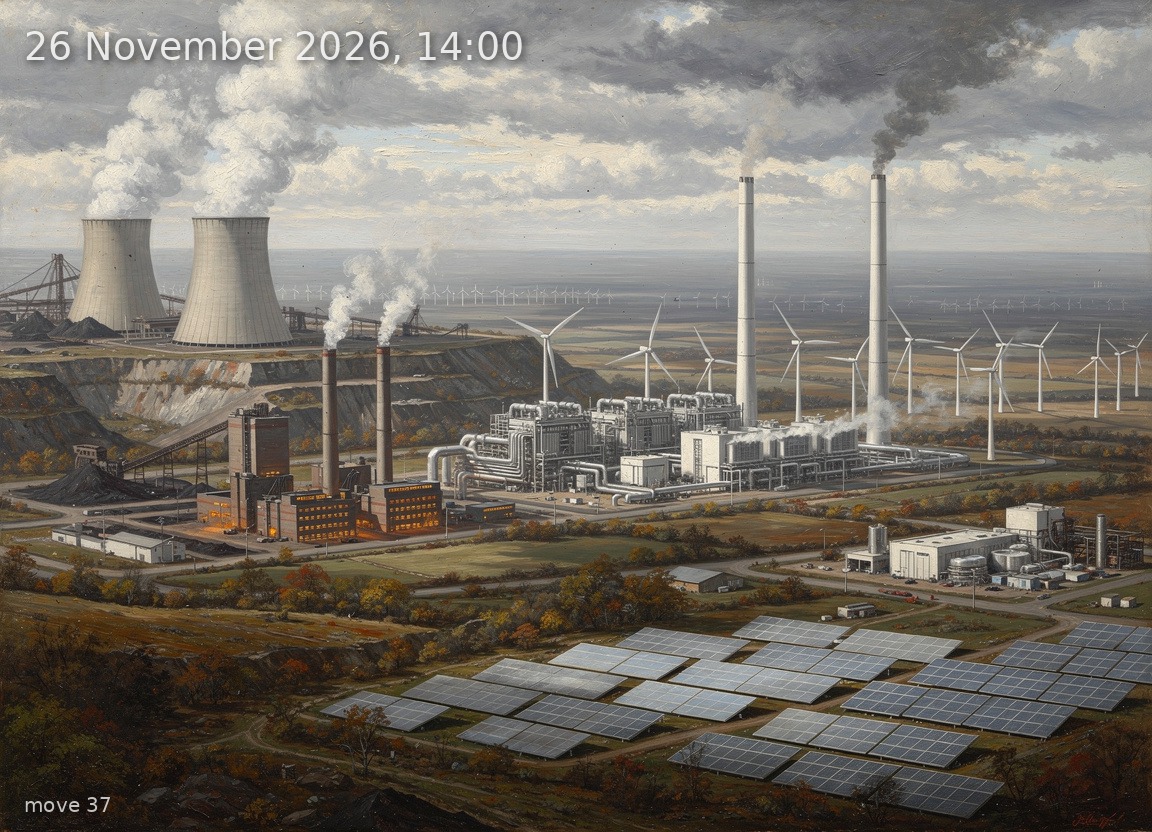
Gas, brown coal, and hard coal anchor a tight grid as cold weather drives 68 GW demand amid limited renewables.
Generation mix
Wind onshore 16%
Wind offshore 5%
Solar 11%
Biomass 8%
Hydro 2%
Natural gas 28%
Hard coal 10%
Brown coal 20%
42%
Renewable share
12.0 GW
Wind (on + offshore)
6.2 GW
Solar
57.6 GW
Total generation
10.7 GW
Net import
334.5 EUR/MWh
Day-ahead price
1.2°C / 12 km/h
Temp / Wind speed
Open-Meteo, Kassel (51.3°N 9.5°E) · surface estimate from 100 m wind
82.0% / 95.8 W/m²
Cloud cover / Radiation
380
gCO₂/kWh
Image prompt
Natural gas 16.1 GW dominates the center-right of the composition as a dense cluster of combined-cycle gas turbine plants with tall single exhaust stacks venting thin white plumes; brown coal 11.6 GW occupies the left quarter as massive hyperbolic cooling towers with thick billowing steam columns rising from a sprawling lignite complex with conveyor belts and open-pit mine edges visible; hard coal 6.0 GW appears center-left as a pair of large conventional power stations with tall chimneys and coal bunkers; wind onshore 9.1 GW stretches across the mid-ground as dozens of three-blade turbines on lattice and tubular towers, blades turning moderately in 12 km/h wind; wind offshore 2.9 GW is suggested in the far distance as a line of turbines on the hazy horizon above a grey sea; solar 6.2 GW appears as scattered fields of aluminium-framed crystalline silicon panels in the right foreground, their surfaces dull under overcast skies, catching only faint diffused light; biomass 4.6 GW shows as a mid-sized industrial plant with a wood-chip storage dome and modest steam stack on the far right; hydro 1.2 GW is a small concrete dam structure nestled in a wooded valley in the far background. The sky is 82% overcast with heavy grey-white stratocumulus clouds pressing low, only thin patches of weak pale daylight breaking through—full November afternoon daylight at 14:00 but muted and flat. The atmosphere feels oppressive and heavy, reflecting the extreme electricity price. The landscape is late-autumn German lowland transitioning to winter: bare deciduous trees, brown and frost-touched fields, patches of frost on the ground, temperature near freezing. Rendered as a highly detailed oil painting in the tradition of 19th-century German Romantic landscape painters such as Caspar David Friedrich and Carl Blechen, with rich layered colour, visible impasto brushwork, atmospheric depth and haze, dramatic tonal contrasts between the warm industrial glow of furnaces and the cold grey-blue winter sky. Each energy technology is rendered with meticulous engineering accuracy—turbine nacelles, three-blade rotors, cooling tower hyperboloid geometry, CCGT exhaust stacks, PV panel grid patterns. The composition conveys industrial sublime: a vast working landscape under a brooding winter sky. No text, no labels.