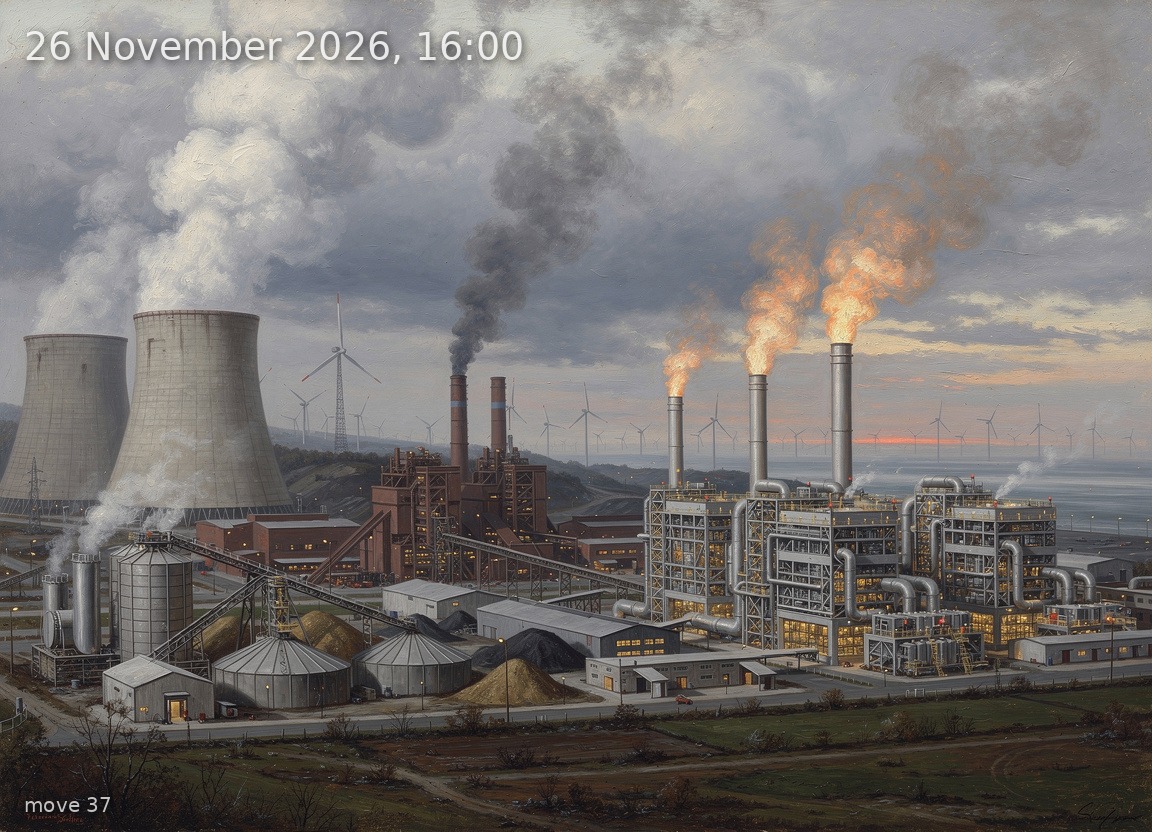
Gas, brown coal, and hard coal dominate as near-zero solar, cold temperatures, and high demand drive 373 EUR/MWh prices.
Generation mix
Wind onshore 20%
Wind offshore 6%
Solar 0%
Biomass 8%
Hydro 2%
Natural gas 30%
Hard coal 11%
Brown coal 21%
37%
Renewable share
14.3 GW
Wind (on + offshore)
0.1 GW
Solar
54.2 GW
Total generation
15.1 GW
Net import
373.1 EUR/MWh
Day-ahead price
0.1°C / 13 km/h
Temp / Wind speed
Open-Meteo, Kassel (51.3°N 9.5°E) · surface estimate from 100 m wind
91.0% / 6.3 W/m²
Cloud cover / Radiation
408
gCO₂/kWh
Image prompt
Natural gas 16.5 GW dominates the centre-right of the scene as a dense cluster of combined-cycle gas turbine plants with tall slender exhaust stacks venting hot plumes into the frigid air; brown coal 11.6 GW fills the left third with massive hyperbolic cooling towers releasing thick white steam columns that merge with the low overcast; hard coal 6.0 GW appears as a pair of industrial coal-fired stations with rectangular chimneys just left of centre; wind onshore 11.1 GW stretches across the far background as dozens of three-blade turbines on lattice and tubular towers rotating steadily on a low ridge; wind offshore 3.2 GW is suggested by distant turbines barely visible on a grey sea horizon at far right; biomass 4.5 GW appears as mid-sized industrial plants with wood-chip storage domes and modest stacks emitting pale smoke in the centre-left middle ground; hydro 1.3 GW is a small concrete run-of-river station with water flowing through gates at the near right foreground along a dark winter river. Time is 4 PM in late November — the last remnants of winter daylight, a pale grey-white sky with 91% cloud cover pressing low and heavy, no sun visible, the horizon showing only the faintest ashen glow before imminent dusk; the atmosphere is oppressive and leaden, reflecting extreme electricity prices. Temperature is just above freezing — bare black trees with frost-rimmed branches, patches of frost on brown dead grass, breath-like vapour rising from every stack and tower. No solar panels anywhere — the light is too dim and diffuse. The landscape is flat north German industrial lowland. Style: a highly detailed oil painting in the tradition of 19th-century German Romantic landscape art — rich impasto brushwork, atmospheric chiaroscuro depth, dramatic tonal contrasts between the warm amber glow of lit industrial windows and the cold slate-grey sky. Every technology rendered with meticulous engineering accuracy: three-blade rotor profiles, hyperbolic concrete cooling tower geometry, aluminium-clad CCGT housings, riveted coal-plant superstructures. The painting conveys the monumental industrial effort of keeping a nation warm and lit as winter darkness descends. No text, no labels.