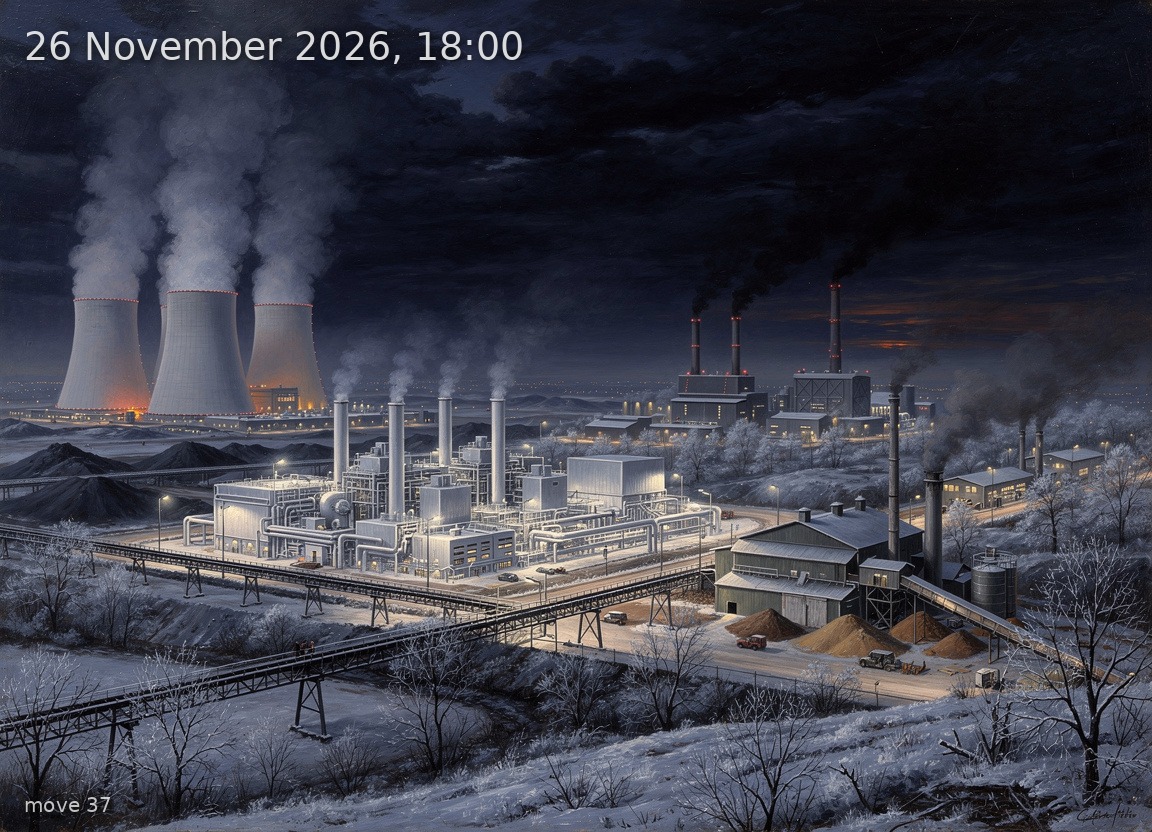
Gas, brown coal, and wind dominate as cold, dark evening peak drives high imports and elevated prices.
Generation mix
Wind onshore 23%
Wind offshore 6%
Biomass 8%
Hydro 2%
Natural gas 30%
Hard coal 11%
Brown coal 21%
39%
Renewable share
16.1 GW
Wind (on + offshore)
0.0 GW
Solar
56.4 GW
Total generation
14.2 GW
Net import
376.0 EUR/MWh
Day-ahead price
-1.1°C / 9 km/h
Temp / Wind speed
Open-Meteo, Kassel (51.3°N 9.5°E) · surface estimate from 100 m wind
80.0% / 0.0 W/m²
Cloud cover / Radiation
394
gCO₂/kWh
Image prompt
Wind onshore 12.8 GW and wind offshore 3.3 GW together span the right third of the scene as dozens of three-blade turbines with lattice towers on frozen hilltops and a distant offshore cluster on a dark sea horizon; natural gas 16.8 GW dominates the centre-left as a large complex of compact CCGT units with tall single exhaust stacks venting pale combustion plumes; brown coal 11.6 GW occupies the far left as massive hyperbolic cooling towers releasing thick white steam columns into the frigid air, with conveyor belts of dark lignite visible below; hard coal 5.9 GW appears as a mid-sized coal-fired station with twin chimneys and red aviation warning lights between the lignite plant and gas complex; biomass 4.6 GW is rendered as a cluster of medium industrial buildings with wood-chip silos and modest stacks emitting thin grey smoke in the centre-right; hydro 1.4 GW appears as a small dam with spillway in the far right background near a frozen river. No solar panels anywhere — it is fully dark. The sky is a deep navy-black winter evening, 80% overcast with heavy low clouds faintly lit from below by sodium-orange industrial lighting and the glow of furnaces. Temperature is -1.1 °C: frost covers the bare branches of leafless deciduous trees, the ground is hard and dusted with ice crystals, and breath-like condensation curls from every exhaust. The atmosphere is heavy and oppressive, reflecting the extreme 376 EUR/MWh price — a leaden, claustrophobic ceiling of cloud pressing down on the industrial landscape. Sodium streetlights cast amber pools along access roads connecting the facilities. Powerlines recede into the murky distance, suggesting the import corridors. Painted in the style of a highly detailed 19th-century German Romantic oil painting — rich impasto brushwork, deep chiaroscuro contrasts between furnace glow and winter darkness, atmospheric depth with mist and steam layering into the distance — yet every turbine nacelle, cooling tower, and CCGT stack is rendered with meticulous engineering accuracy. No text, no labels.