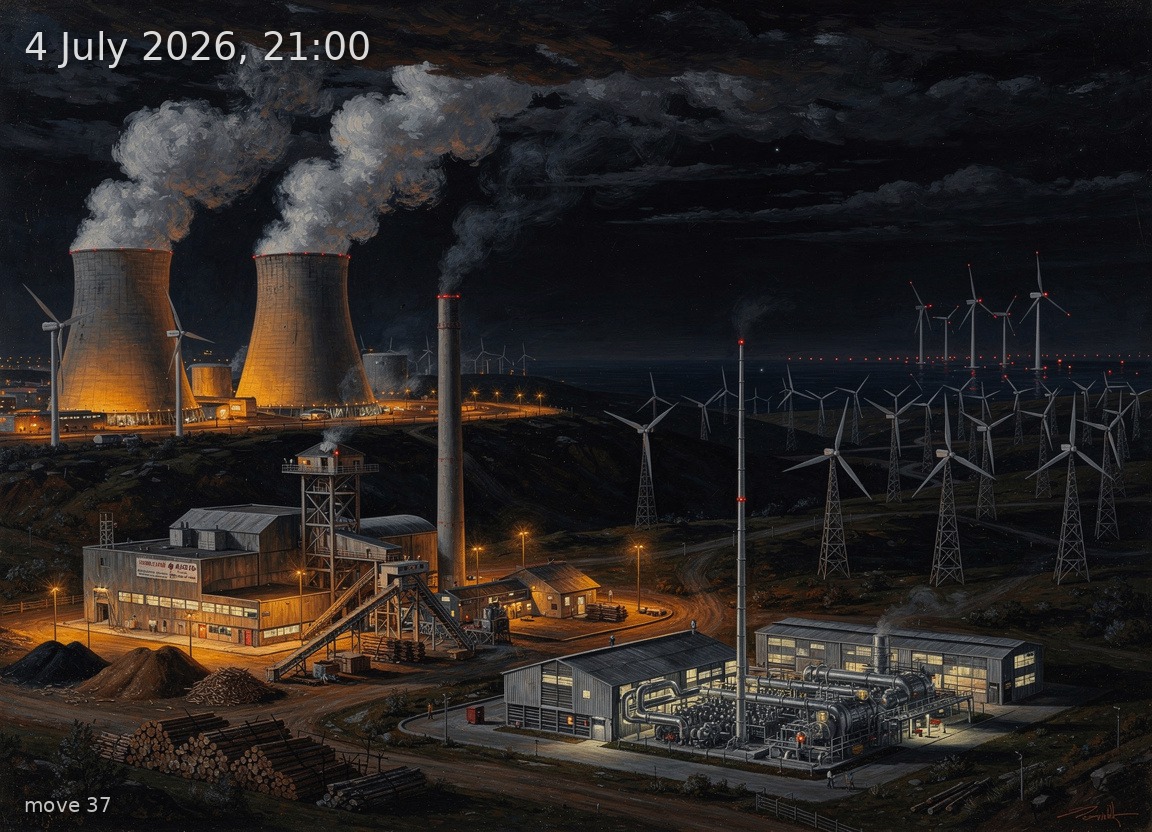
Wind dominates at 21.4 GW but 12.4 GW net imports needed as solar fades and evening demand peaks.
Generation mix
Wind onshore 46%
Wind offshore 15%
Solar 1%
Biomass 12%
Hydro 4%
Natural gas 10%
Hard coal 3%
Brown coal 9%
78%
Renewable share
21.5 GW
Wind (on + offshore)
0.2 GW
Solar
35.1 GW
Total generation
12.4 GW
Net import
131.0 EUR/MWh
Day-ahead price
21.3°C / 19 km/h
Temp / Wind speed
Open-Meteo, Kassel (51.3°N 9.5°E) · surface estimate from 100 m wind
97.0% / 11.0 W/m²
Cloud cover / Radiation
144
gCO₂/kWh
Image prompt
Wind onshore 16.0 GW dominates the right two-thirds of the composition as vast ranks of three-blade turbines on lattice towers stretching across rolling hills into deep darkness, rotors visibly turning in moderate wind; wind offshore 5.4 GW appears as a distant cluster of larger turbines on the far-right horizon, faint red aviation lights blinking against a black sky; biomass 4.4 GW occupies the centre-left as a mid-sized industrial plant with a timber yard and smoldering stack, warmly lit by sodium lamps; natural gas 3.4 GW sits left of centre as a compact CCGT facility with a single tall exhaust stack emitting a thin heat shimmer, interior lights glowing through metal-clad walls; brown coal 3.2 GW fills the far left as a pair of hyperbolic cooling towers with heavy white steam plumes rising into the night, underlit by orange industrial floodlights; hydro 1.4 GW appears as a small concrete dam structure nestled in a valley in the mid-ground, water gleaming faintly; hard coal 1.0 GW is a single smaller stack behind the brown coal plant, barely visible. The sky is entirely dark — a deep navy-black with no twilight glow, no sunset remnant, heavy 97% cloud cover creating an oppressive low ceiling that reflects the amber sodium light pollution from below. Temperature is a mild 21°C summer night; lush green vegetation on hillsides is barely perceptible in artificial light, leaves stirring in the wind. The atmosphere is heavy and pressing, reflecting the high 131 EUR/MWh electricity price — a sense of industrial strain and urgent generation. Scattered farmhouse windows glow golden in the middle distance. Power transmission lines with red warning lights thread between the installations. Highly detailed oil painting in the tradition of 19th-century German Romantic landscape painters — rich, dark colour palette of deep blues, blacks, warm ambers, and industrial oranges; visible impasto brushwork; dramatic atmospheric depth and chiaroscuro lighting; meticulous engineering accuracy in every turbine nacelle, cooling tower curve, and exhaust stack detail. No text, no labels.